2000 to 2002 Challenges of the New Millennium
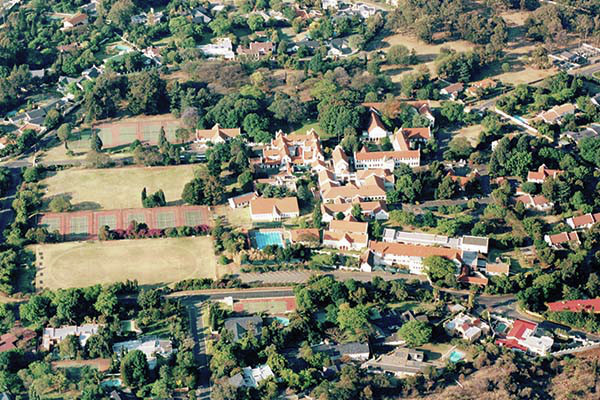
Aerial photograph taken in 2003 shows the school much as it was in 2000
- 2000 Turn of the millennium
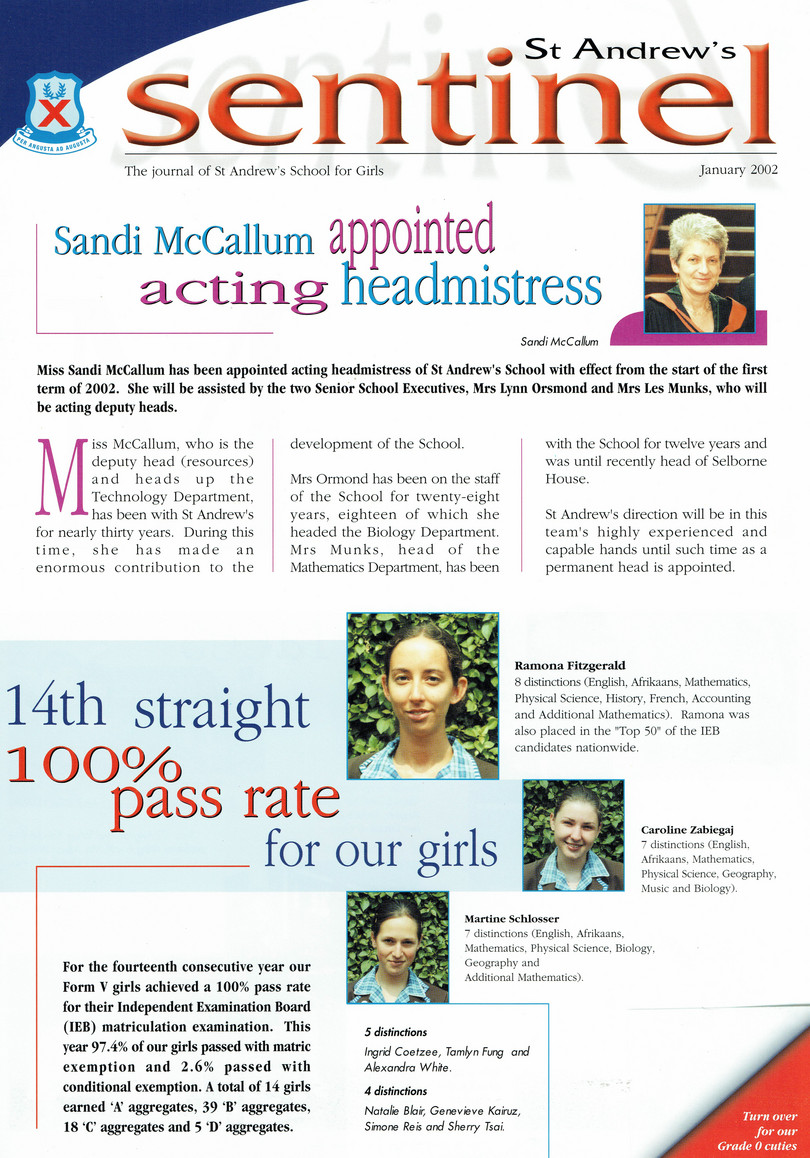
- January 2002 Ms Sandi McCallum is appointed acting head and MOMs executive team oversees the school
- 2002 St Andrew’s celebrates its centenary
- 2003 Mrs Pauline Jackson becomes headmistress
Overview
More than two decades after the turn of the millennium, it’s easy to forget how significant the milestone seemed at the time.
As the year 2000 approached, Y2K fever was in full force across the globe. There was a heady mix of anxiety and excitement about what the turning of the clock might mean as we started not just a new year, but also a new decade, new century and new millennium.
What was the fuss about Y2K?
Y2K stands for “Year 2000” (K is commonly used to represent the number 1000) and the Y2K bug was a computer flaw that had the world worried about dealing with dates after 31 December 1999. It was also known as “the millennium bug”.
Essentially, many computer programs used a two-digit code for the year (e.g. 1999 would have been written “99”, with the “19” left out). Programmers worried that computers might interpret “00” as 1900 instead of 2000. This could cause major issues in power plants (which use computer data for safety checks), banks (which use computer-generated dates to calculate interest) and transport systems, among others.
Some people were so worried about what might happen that they stocked up on food, water and cash, and prepared doomsday bunkers.
Thankfully, software engineers were able to fix most of the problems by expanding the date format to four digits, and other than a few isolated incidents (such as an energy facility in Japan where some radiation equipment failed), the year 2000 went off with barely a hitch.
St Andrew’s too faced a period of immense uncertainty and upheaval in the early years of the new millennium. With the advent of new technologies, the introduction of outcomes-based education, the phasing out of government subsidies for private schools and the increasing formalisation of school management structures, the school – like many – found itself in a challenging position.
With St Andrew’s own centenary approaching in 2002, what should have been a time of consolidation and celebration was instead fraught with difficulties. The school was not in a strong financial position and there was friction between the members of the school’s leadership teams.
Things culminated with the abrupt departure of headmistress Mrs Allison Gunning in October 2001. One of the two deputy heads, Mrs Mary Williams, had already accepted a position as headmistress at another school and was only able to take on the role of acting executive headmistress until the end of 2001, which meant St Andrew’s was left without an executive headmistress for the centenary year. Thankfully, the other deputy head, Ms Sandi McCallum, was willing to step in.
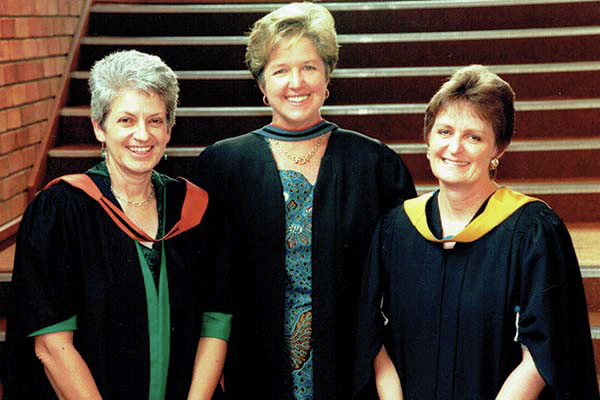
Speech Night 2000 at the Linder Auditorium
L–R: Ms Sandi McCallum, Mrs Allison Gunning, Mrs Mary Williams
The board of directors approached Ms McCallum, as well as two other senior and respected St Andrew’s teachers who were already members of the Senior School executive team, to take up the mantle of leadership during the interim period as it initiated the search for a suitable new headmistress.
Ms McCallum was appointed as the acting executive headmistress and Mrs Lynn Orsmond and Mrs Les Munks as acting deputy headmistresses. These three women – the so-called ‘MOMs’ (an acronym of their surnames) – stepped in to steady the ship and carry the school into the new century.
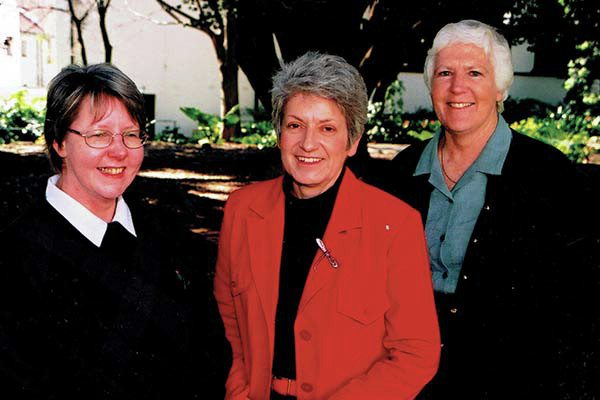
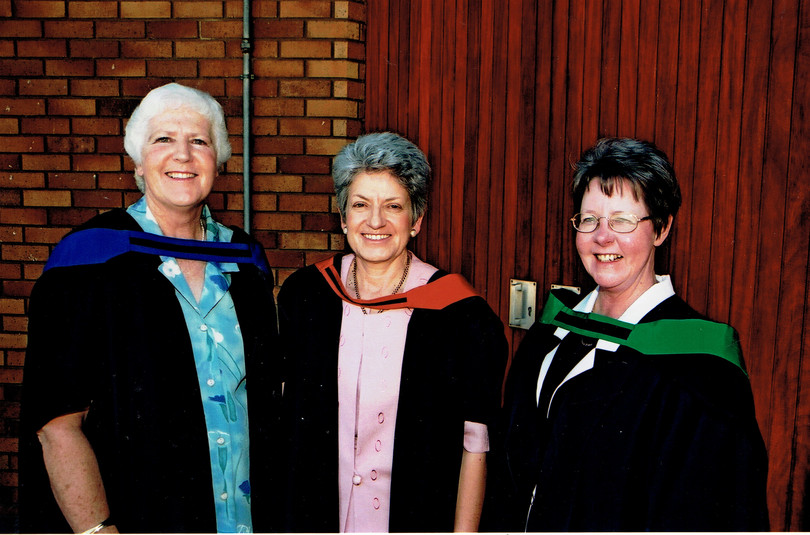
The MOM’s leadership team, 2002
L–R: Mrs Les Munks, Ms Sandi McCallum, Mrs Lynn Orsmond
They worked closely with the board of directors, the board of trustees, the Parents’ Association, the Old Girls’ Association, their colleagues and the girls to make the 2002 centenary celebrations a resounding success.
It was a fitting way to mark the centenary – with thanks for the school’s history and for all those who helped to create its enduring legacy, as well as signalling a changing of the guard and the advent of an era that would usher in many new things for the school.
In 2003, the MOMs team handed over the reins to Mrs Pauline Jackson and gracefully returned to their former leadership positions, with the gratitude of the girls, parents, teachers and management teams.
The new millennium
Millenium gallery The new millennium
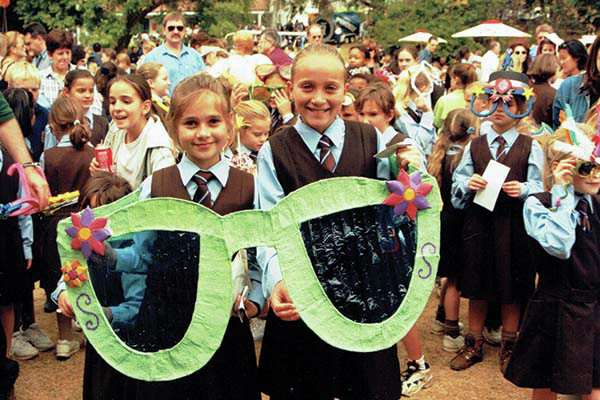
Millenium gallery 2 Millennium sunglasses challenge won by sisters Whitney and Jessica Taggart, 2000
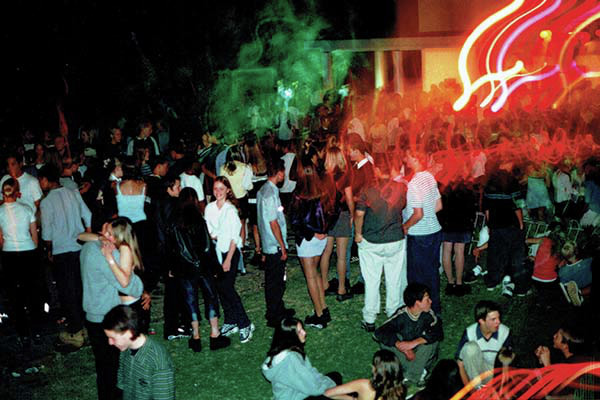
Millenium gallery 3 Parents’ Association millennium social
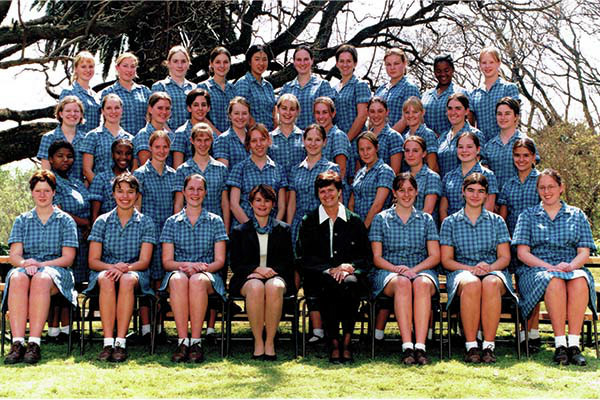
Millenium gallery 4 Millennium European tour group with leaders Mrs Philippa Spencer (L) and Mrs Hélène Heyns in front row, centre, 2000
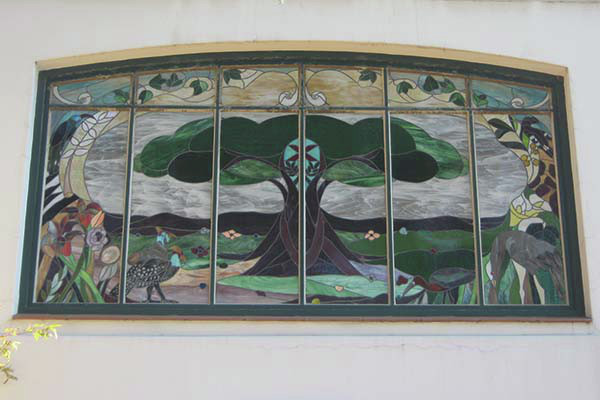
Millenium gallery 5 The stained-glass window at the entrance to the Allister Rogan Auditorium, designed by Carolyn Morrison and donated by the Evans family in 2000. Robyn Evans was head girl in 1996. With permission, the camelthorn tree depicted in the window has been adopted as the school’s values tree
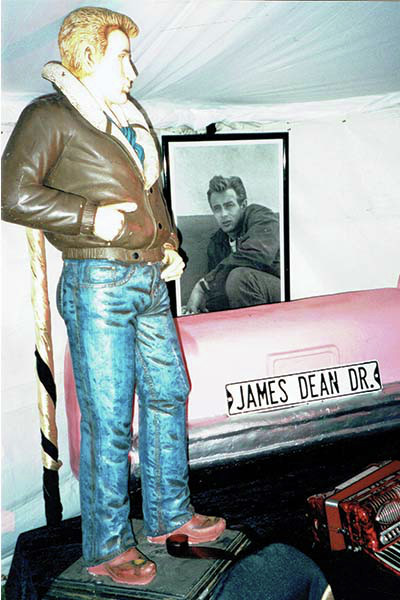
Millenium gallery 6 2000 Matric Dance with a ‘James Dean’ theme
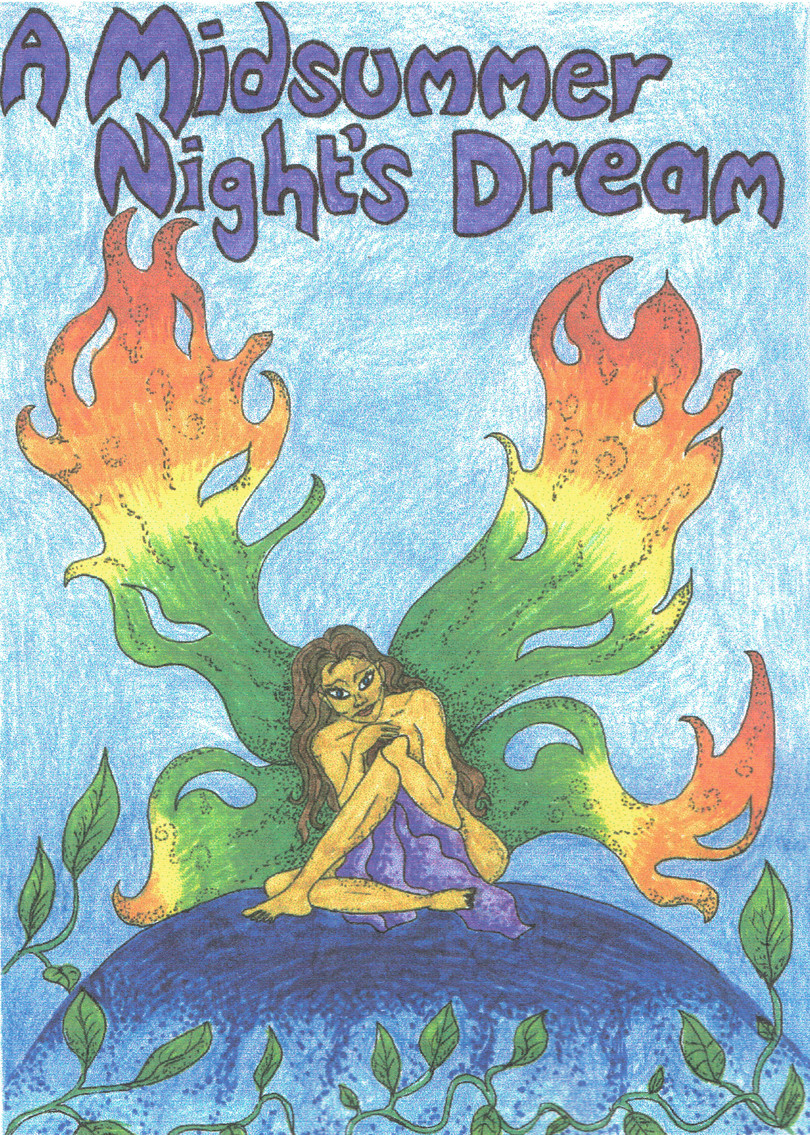
Millenium gallery 7 Programme cover for the school production of ‘A Midsummer Night’s Dream’. Designed by Louise Hutchinson

St Andrew’s Sings, the second CD made by the St Andrew’s choirs, 2000
Audio 1.1 Track 9 from St Andrew’s Sings: Look at the World’ by John Rutter. Sung by the Senior Choir
Audio 1.2 Track 12 from St Andrew’s Sings: ‘All Creatures of Our God and King’ by C S Tocher. Sung by the Cantate Filiae Choir
Audio 1.3 Track 23 from St Andrew’s Sings: ‘Balulalow’ by Benjamin Britten. Sung by the Nova Cantica Choir with soloist, Christine Hambidge
The ties that bind
In a school as multifaceted as St Andrew’s, relationships are an essential part of how well or poorly it functions. Many of the people who, over the years, joined the St Andrew’s community as teachers, pupils and staff did so because of personal connections to the school.
For instance, Mrs Ann Wright, who started at St Andrew’s as a part-time Junior School teacher in 1987, found a warm welcome when she met then-headmaster Mr Frank Simmonds. She was enrolling her nine-month-old daughter, Emma, at the school and when Mr Simmonds learned that Mrs Wright’s husband, Dave, had once been a pupil of his, Emma was swiftly welcomed into the Grade 0 intake. When she began attending classes, Mrs Wright was invited to apply for the second Grade 3 post the school was looking to fill in 1990. She says it was down to her husband’s connection to Mr Simmonds that she and Emma both ended up at St Andrew’s.
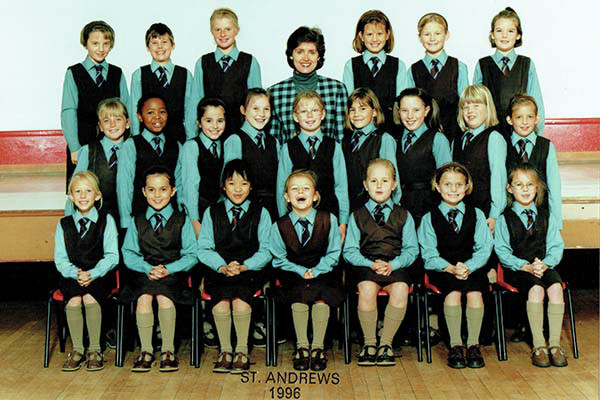
Mrs Ann Wright’s class in 1996, when her daughter Emma was in Form V
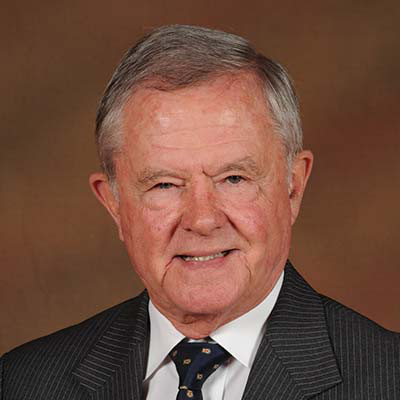
Mr Allister Rogan, 2002
Mr Allister Rogan, who was the chairman of the board from 1990 to 1998 and the inaugural chairman of the re-formed St Andrew’s Trust of 2000, became involved with St Andrew’s because of a personal connection with Mr Simmonds. As a former teacher at St John’s, Mr Simmonds had many affiliations that he continued to cultivate and invest in the St Andrew’s community.
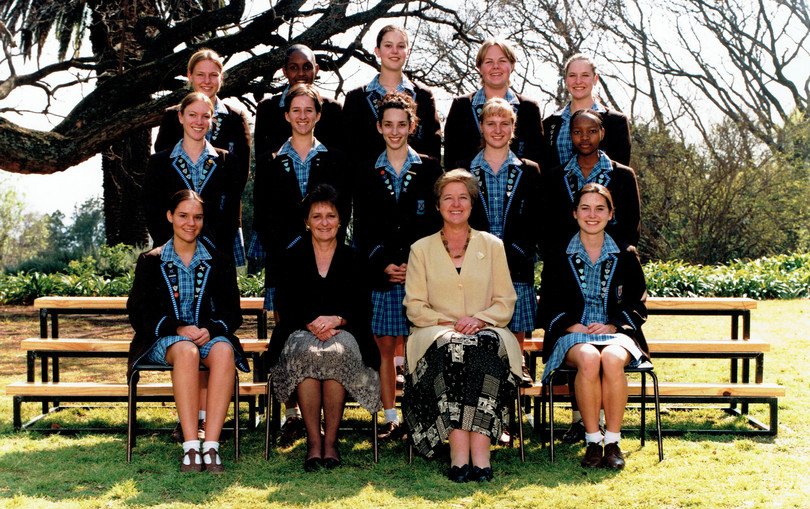
Student leadership in 2000 ‘The Group of Twelve’
Back Row L–R: Andrea Cox (deputy head, Milner); Muchero Nyazema (deputy head, Boarding); Sarah Laurence (deputy head, Selborne); Joanne Gelling (deputy head, Farrar); Judy Maskew (deputy head, Athlone)
Middle Row: Georgina Jephson (head, Milner); Kejenne Beard (head, Selborne); Roxanne Kairuz (head, Farrar); Diana Noble (head, Athlone); Delina Manzini (head, Boarding)
Front Row: Tenille Sachs (deputy head girl); Mrs Mary Williams (deputy headmistress); Mrs Allison Gunning (headmistress); Catherine Roux (head girl)
“On thinking about what makes St Andrew’s such a special environment, I have to say that it is perhaps the relationships formed which have stood out for me the most.” Catherine Roux, head girl, 2000 (Speech Day Address)
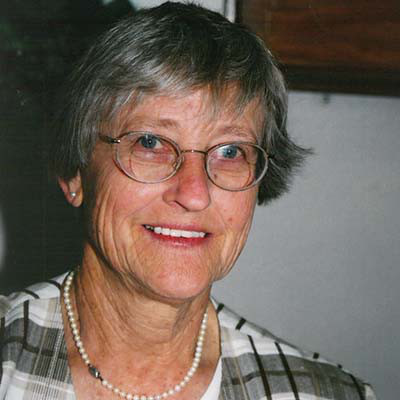
Mrs Bridget Walton at the Matric Girls’ and Moms’ Lunch in 2002
Legendary former headmistress of the Junior School, Mrs Bridget Walton, moved from Kenya to South Africa. When she had her interview with then-headmistress Mrs Mary Hunt, they discovered that they had both trained at the same teacher training college in England. This became a valuable bond in their working relationship.
uBambiswano is a St Andrew’s School for Girls social development initiative, run since 1992. The Saturday School programme, prioritising literacy, numeracy, educational and life skills, is attended by students from Daveyton and Etwatwa. For more information, go to www.ubambiswano.com.
Mrs Walton continues to be a remarkable example of the value of relationships in the St Andrew’s community. She has won the hearts, loyalty and admiration of many teachers, support staff members, parents, management teams, and, most importantly, learners, through her commitment to education and immense love for people connected in any and all ways to school life. Despite having left St Andrew’s at the end of 1995, she is still actively invested in pupils at uBambiswano, former pupils, and both past and present staff members.
In the final years of Mrs Gunning’s tenure, there were differences on many levels that led to the need for new leadership at the school. As the head who took over from Mr Simmonds, Mrs Gunning would always have had large shoes to fill. Many of the academic and sporting changes that she introduced during her tenure laid good foundations for the school, but in the final few years of her headship, her management style proved challenging for many staff members and parents, as well as the board of directors. Misalignment and miscommunication ultimately led to an irreconcilable breakdown of trust and relationships.
Financially, the school was also in a difficult position and needed a firm leadership team to help overcome some of the challenges faced by outstanding tax commitments, families defaulting on fees and a shortage of about 100 pupils across the school, putting a strain on income.
MOMs to the rescue
While the process to find a new executive head was under way, Ms McCallum, Mrs Orsmond and Mrs Munks took on the challenge of overseeing the school and provided exceptional leadership. They were each given different areas of responsibility and oversight and, as Mrs Orsmond explains, “The three of us, each brought something very different… and somehow it worked. The school managed to flourish.”
Speech Night 2002 at the Linder Auditorium
L–R: Mrs Lynn Orsmond, Ms Sandi McCallum, Mrs Les Munks
Ms McCallum had spent almost 30 years at St Andrew’s and had successfully introduced technology as a subject to the school when she was asked to step in as acting headmistress. Mrs Orsmond was heading up the biology department and had been at the school for 27 years. Mrs Munks had been with the school for 12 years and was department head for mathematics.
Mr Lindsay Robertson, who was the outgoing chairman of the board of directors at the time, commends the work done by the MOMs team. “They did an extremely good job, and the school, instead of falling apart [in the wake of Mrs Gunning’s departure], actually strengthened.”
The three women continued to serve the school, with Ms McCallum holding the role of deputy to Mrs Jackson from 2003, before leaving St Andrew’s in 2005, after 34 years of service. In her Speech Day address, Mrs Jackson quoted the 2005 Matrics as saying, “We’re losing the ‘jam’ in the school. She [Ms McCallum] keeps it all together.”
Mrs Orsmond returned to her position as head of biology, retiring in 2006, and Mrs Munks remained head of mathematics until 2007 when she, too, retired.

2002 leaders: The Group of Twelve
Back Row L–R: Roxanne Kemp (deputy head, Farrar), Natasha Allie (deputy head, Athlone), Samantha Austen (deputy head, Milner), Gaobolelwe Mokgoro (deputy head, Selborne), Nomsa Mazwai (head, SRC)
Middle Row: Kagiso Motse (head, Boarding), Shannon-Lee Edwards (head, Farrar), Kathryn Holland (head, Athlone), Katiso Maarohanye (head, Milner), Bronwyn Jackson (head, Selborne)
Front Row: Mrs Les Munks (acting deputy headmistress), Masechaba Bookholane (head girl), Miss Sandi McCallum (acting headmistress), Caren Biddulph (deputy head girl), Mrs Lynn Orsmond (acting deputy headmistress)
The MOMs leadership team worked alongside the centenary year’s Matric team of student leaders, under head girl Masechaba Makgolane (née Bookholane). Despite the fluctuations in the executive leadership of the school, the girls were committed to serving the school in their roles. As Masechaba explains, “We wanted to make the best of this year and we still wanted it to be a strong Matric year that would be remembered.”
“I genuinely loved school. I had some of my best days there with some of my closest friends. I’m still friends with them now. And I think for me, I felt like I was a product of the school because when you’re at a place from the age of five, and you stay there until you’re 18, there’s a sense of that. I felt a real sense of community and a real sense of belonging, which I loved.” Masechaba Makgolane (née Bookholane), centenary head girl, 2002
Centenary celebrations

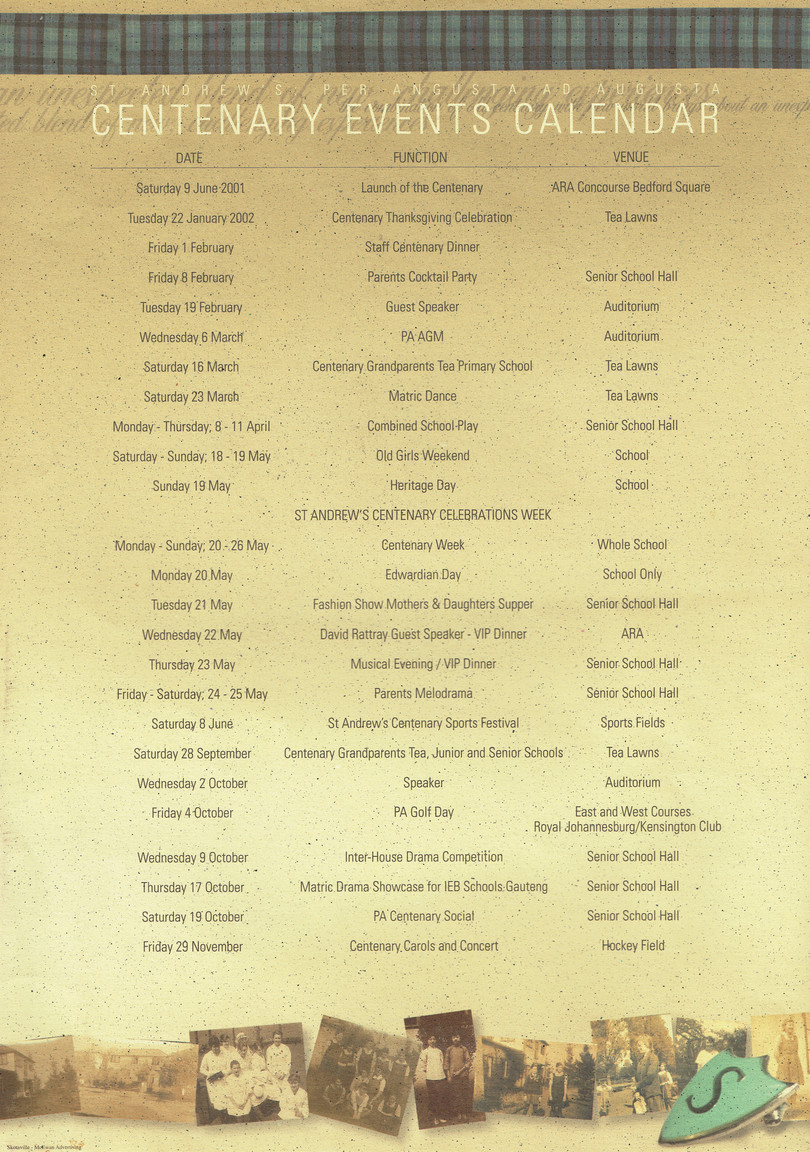
In the midst of the unexpected challenges of the new millennium, St Andrew’s did still have the remarkable achievement of its 100th anniversary to celebrate. In such a lively, youth-filled environment, it would have been remiss to let this monumental milestone pass without significant fanfare. The Centenary Committee was chaired by Mrs Anne-Marie Moore (née Hartley, 1964), past chairwoman of the Old Girls’ Association and a past parent. The centenary programme of events was launched in June 2001 at the Open Day.
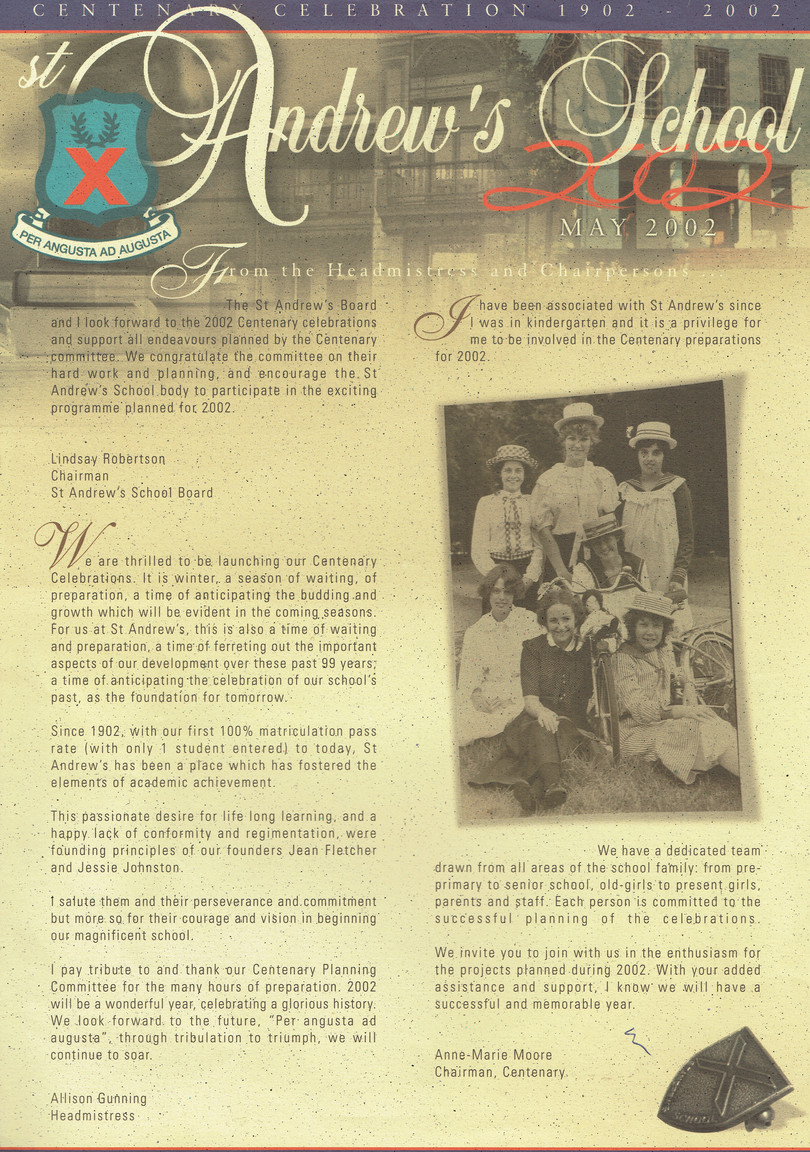
Centenary brochure
Centenary brochure Centenary brochure
Centenary brochure 1 Centenary brochure, first page
Centenary brochure 2 Centenary brochure, last page
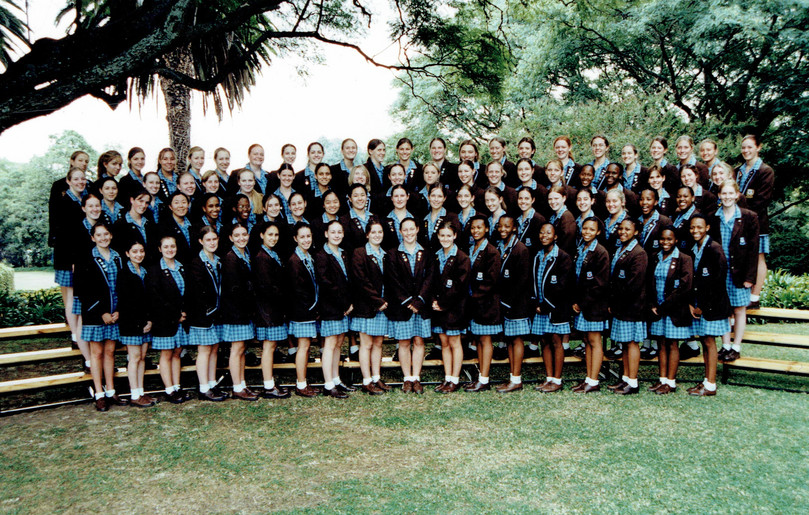
Class of 2002
Back Row L–R: Bonnie-Louise McMillan, Diana Altgayer, Lara Noble, Shannon-Lee Edwards, Tessa Lefrere, Chantell Mouton, Deborah van der Linden, Natasha Fagri, Nicole Raath, Juliette van Staden, Fleur Loram, Devon Culverwell, Genevieve van Staden, Roslynde Saunders, Siobhan Brink, Paola Trevisan, Jeanette Bensted-Smith, Tamsin Cracknell, Christine Hambidge, Roxanne Kemp, Kathryn Holland, Tenielle Haw
Third Row: Kerry-Lee Lancaster, Lauren Weir, Andrea Hammond, Michelle Hansmeyer, Bronwen du Plooy, Chantal Duyver, Margot Timberlake, Kimberly Hinze, Marianne Ball, Andrea Wintour, Nicole Hijbeek, Rhoda Kellner, Victoria Bannatyne, Taryn Oliver, Carly Appleby, Katiso Maarohanye, Kagiso Motse, Jessica Partner, Kate Webber, Michelle Andrews
Second Row: Sara Graham, Nicole Vos, Ting Ting Song, Natasha Allie, Masechaba Bookholane, Carla Hart, Aimee Purchase, Lin-Chung Huang, Kristin Fung, Georgina Alexander, Samantha Austen, Carey Dixon, Bodene Keylock, Caren Biddulph, Kirsty Berry, Natasha Jurkovic, Lauren Dickson, Nomsa Mazwai, Mwayi Ngondo, Sally Johns
Front Row: Bronwyn Jackson, Nabila Mayet, Romina Cantarin, Joslin Andrews, Andrea de Barros, Cindy-Leigh Florentino, Tanya Madureira, Kelly Sanders, Dione Mentis, Lesley Phillips, Katya de Oliveira, Realebogo Chaphole, Noluvuyo Mkhondo, Tebogo Leshilo, Gaobolelwe Mokgoro, Afika Macingwane, Tutsirai Kaseke, Khomotso Maimela
Absent: Catherine Gray, Danielle Thompson
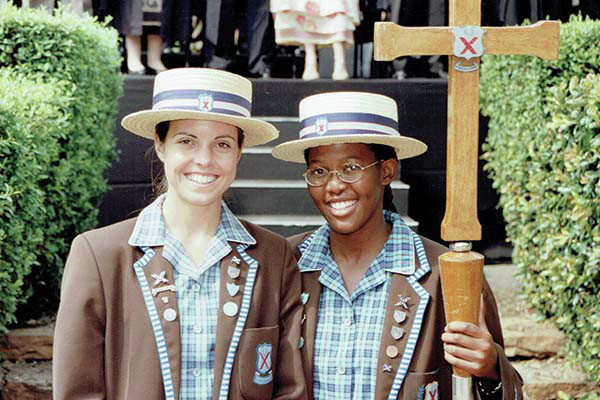
The centenary celebrations began in earnest with a special inter-faith thanksgiving service on 22 January 2002, Founders’ Day, with the procession led by head girl Masechaba Makgolane (neé Bookholane) and deputy head girl, Caren Biddulph.
Founders’ Day Centenary Thanksgiving Service
Founders’ Day Centenary Thanksgiving Service Founders’ Day Centenary Thanksgiving Service
Founders’ Day Centenary Thanksgiving Service 1 Founders’ Day Centenary Thanksgiving Service, 2002. Caren Biddulph (L, deputy head girl) and Masechaba Bookholane (head girl)
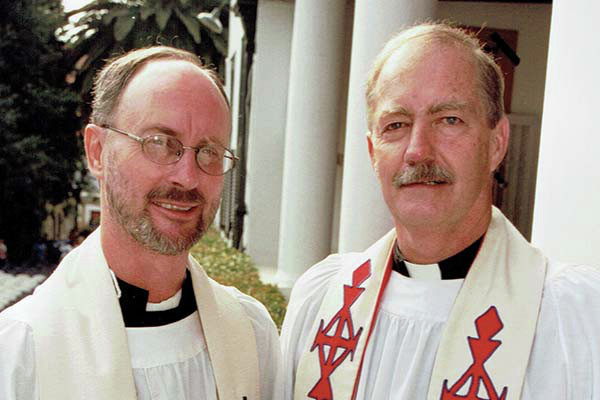
Founders’ Day Centenary Thanksgiving Service 2 The Founders’ Day Centenary Thanksgiving Service was led by Rev Nigel Andrews (L) and Rev Errol Dengler
Founders’ Day Centenary Thanksgiving Service 3
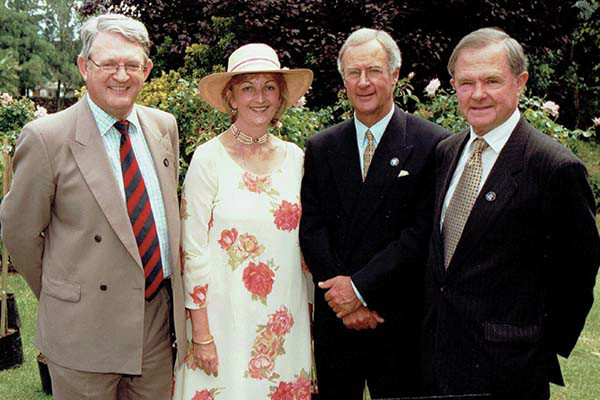
Guests at the Founders’ Day Centenary Thanksgiving Service, 2002
L–R: Mr David Lowry, Mrs Anne-Marie Moore, Mr Lindsay Robertson, Mr Allister Rogan

Founders’ Day Centenary Thanksgiving Service 4 Founders’ Day Centenary Thanksgiving Celebration cake, 2002
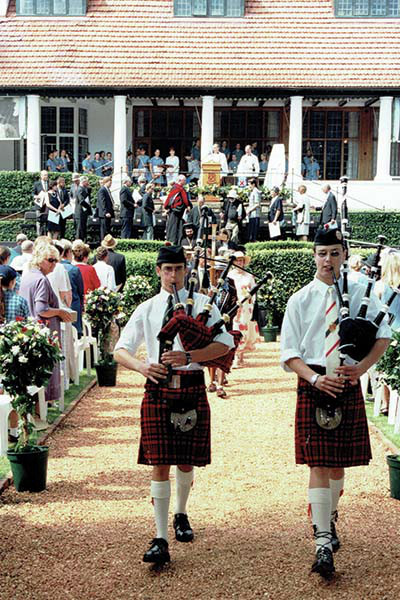
Founders’ Day Centenary Thanksgiving Service 5 Pipers from King Edward School led the procession of special guests at the Founders’ Day Centenary Thanksgiving Service
View a PDF of the programme for the centenary musical production “Rewind… Press Play” here.
There was a multitude of colourful celebrations, including a fashion show, staff dinners, a centenary song composed by Ron Gill, the filling of time capsules, guest speakers, an Old Girls’ lunch, picnics, a soirée, Christmas in July and, of course, cake. There was also a combined school production that year, which included both the Junior School and Senior School in a celebration of music over the decades, called “Rewind… Press Play”.
Audio 1.3 Centenary song. Lyrics, music and recording by Mr Ron Gill. At the time Mr Gill was deputy head and head of music at St Martin’s School but since 2019 has been a part-time music teacher at St Andrew’s
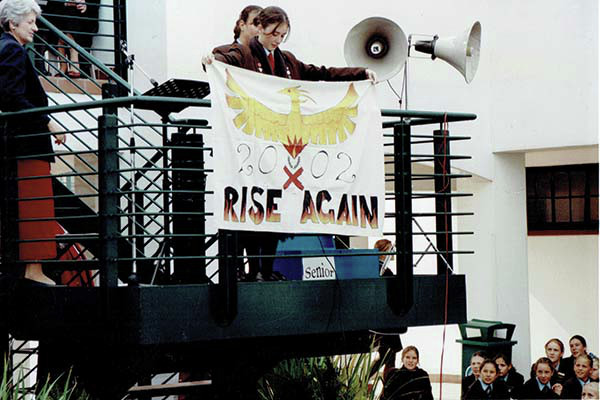
Centenary celebrations on Open Day
Centenary celebrations on Open Day Centenary celebrations on Open Day
Centenary celebrations on Open Day 1 Centenary celebrations in Bedford Square on Open Day

Centenary celebrations on Open Day 2 Filling of the Junior School time capsule at Open Day, 2002
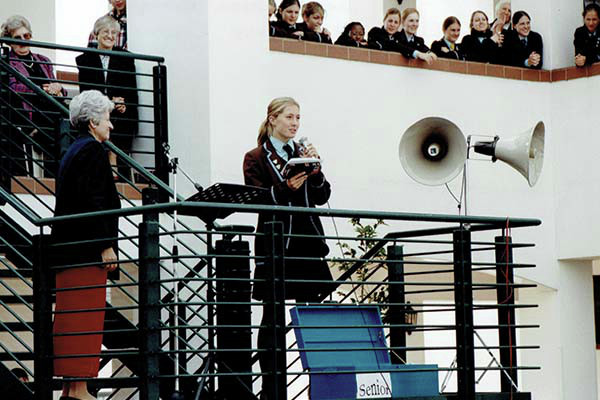
Centenary celebrations on Open Day 3 Filling of the Senior School time capsule on Open Day

More Centenary celebrations
More Centenary celebrations More Centenary celebrations
More Centenary celebrations 1 The Jessie Bear was created for the Centenary in a collectable limited edition. Subsequently, other editions of the Jessie Bear were for sale until a new mascot, Lesedi the Lioness, was launched in 2022 for the 120th anniversary of the school
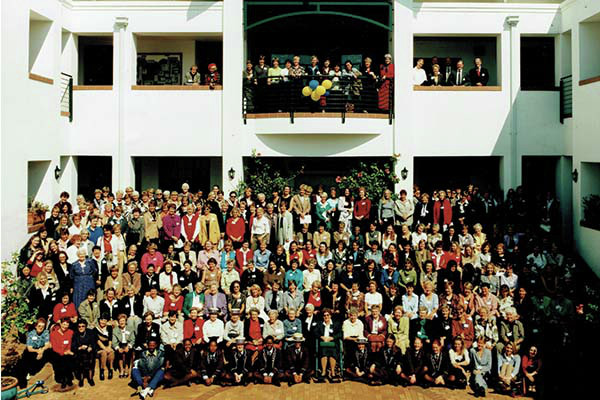
More Centenary celebrations 2 Centenary reunion for the Old Girls’ Association, 18 May 2002
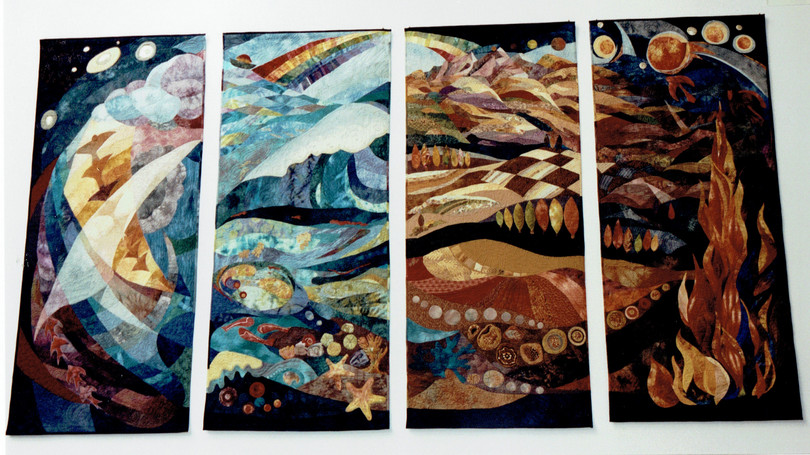
More Centenary celebrations 3 The ‘Elements’ wall hangings, designed and made for the centenary by former teacher, Mrs Kim Tedder. They were initially hung in the ARA concourse but are now on display in the main stairwell of Bedford Court
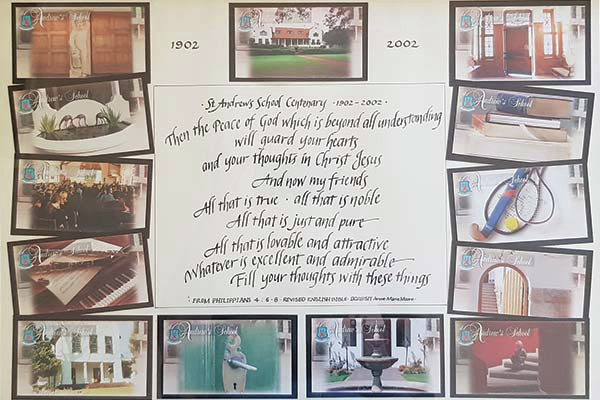
More Centenary celebrations 4 Centenary collage created by Mrs Anne-Marie Moore
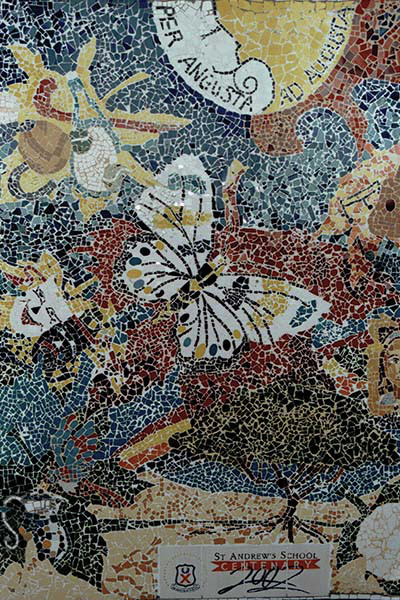
More Centenary celebrations 5 Centennial mosaic created by Grades 4–7 and mounted at the Junior School Hall, now the Aftercare Centre
A celebratory book, The Golden Spoon: A history of St Andrew’s School for Girls 1902–2002 was launched, written by Mrs Dorothy Ede, a former deputy headmistress and long-serving staff member, assisted by Shelagh Bouwer, the archivist at the time.
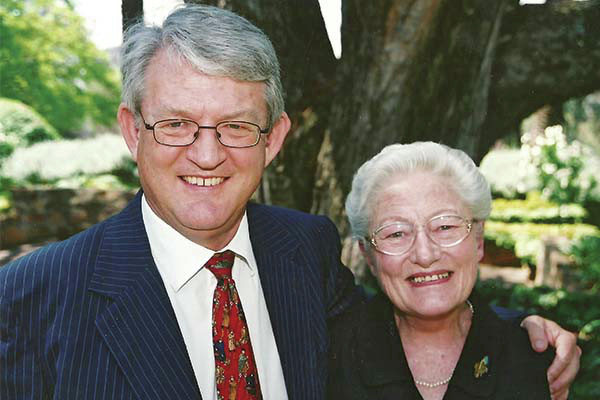
Mr David Lowry, chairman of the board, and former deputy head and author of ‘The Golden Spoon’, Mrs Dorothy Ede, at the book’s launch in 2002
Lasting legacy
Ms McCallum was instrumental in introducing new educational advancements, such as the technology lab. She was deeply involved and invested in the establishment of uBambiswano, served as the head of boarding, and even oversaw some of the school’s earlier building initiatives. Ms McCallum attributes much of St Andrew’s longevity to the pioneering spirit of the school, of which she was an outstanding example. She embraced many new opportunities, often leaping into the unknown and leading the way, just as she did as part of the MOMs team.
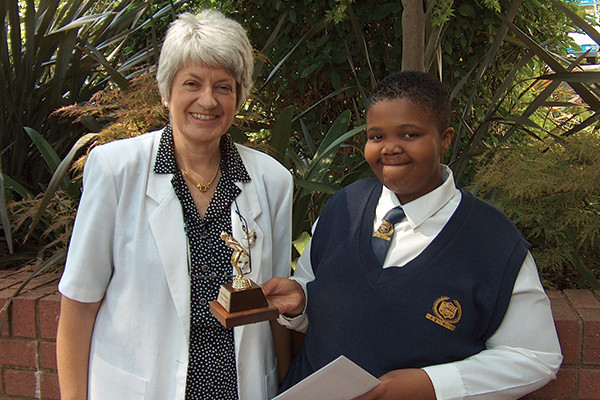
uBambiswano prizegiving 2004: Ms Sandi McCallum with student Ntombikayise Ntuli
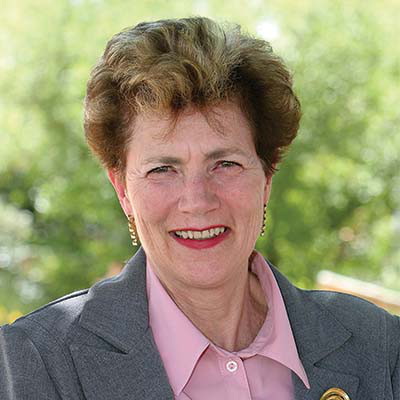
Mrs Barbara Stuart, Junior School head 1996–2006
The Junior School continued under the steady care of Mrs Barbara Stuart, who had taken over from Mrs Walton in 1996, with the support of Mrs Gill Hogg as the head of the Primary School. Mrs Stuart’s focus in leading the Junior School was to prioritise a child-centred approach, working to earn the support of teachers and staff, embracing total honesty and being readily available to parents.
She believes that the longevity of the school can be attributed to the school’s enduring commitment to education, despite the ups and downs of the institution. “It is worthwhile struggling for success. So many girls have made their mark because at St Andrew’s they were taught to think, question and apply themselves diligently in all areas,” she says.
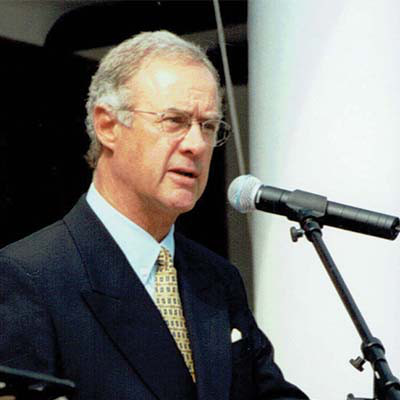
Mr Lindsay Robertson, 2002
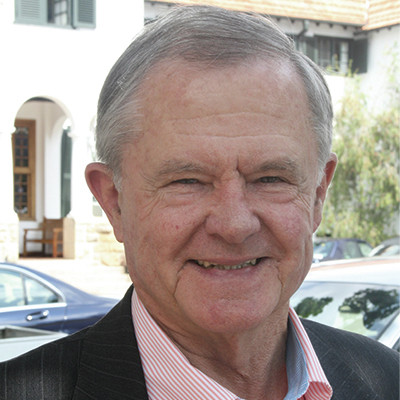
Mr Allister Rogan, 2011
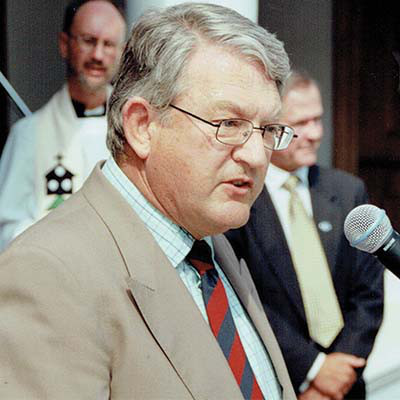
Mr David Lowry, 2002
Others who will be remembered for their role in steering the school through this challenging transitionary period in its history include Mr Rogan, who served the school in many capacities over the years, and the two men who chaired the board of directors during this time – Mr Robertson and Mr David Lowry.
Under Mr Robertson’s leadership of the board of directors, the management and oversight of the school were also well defined and the roles and responsibilities of the board and the school’s executive functions were made clear.
Even as the school worked to improve important governance structures, formalise its management to ensure sustainability into the future, and modernise its systems, Mr Robertson was careful to assure the St Andrean community that this was not an effort to turn it into a business entity.
“St Andrew’s is a school with a distinctive character and not some soulless corporation,” he wrote in his chairman’s letter in the school magazine in 2001. “It should never be run as a business – but it must be managed on sound business principles… I want to assure [parents], however, that the fees and levies they pay will be prudently husbanded and that every cent we spend will be applied to the benefit of their children.”
Mr Lowry was instrumental in appointing Mrs Jackson and in supporting her through weekly meetings and ongoing encouragement. Many of the strategy sessions that would prove invaluable in the school’s progress were also hosted on his farm.
Despite the complexities of Mrs Gunning’s departure, many of the changes she introduced in the earlier years of her time as executive headmistress had a positive impact on the school.
- The new, more modern school uniform was warmly received and continues to help define a sense of belonging for current learners.
- The Simmonds Block and the Frank Simmonds Resource Centre were built during Mrs Gunning’s tenure. These buildings link the Junior and Senior sections of St Andrew’s School physically. They provide new Junior School classrooms and Senior School facilities including a large library, two computer rooms, art rooms, language rooms, an auditorium and a teaching kitchen. The Mackenzie-McLean Library became a new staff meeting and dining space.
- Increased interest in a variety of sports, including the introduction of rowing in 1995, helped pave the way for St Andrew’s golden era as a school that was strong both academically and in sports under the leadership of Mrs Jackson.
- The school began its journey to embrace technology – in 2000, there were already 120 computers at the school and computing lessons were available to girls, staff and even parents.
- Also in 2000, the Employment Consultative Forum submitted the school’s first employment equity report and plan, as well as its first workplace skills development plan.
- Outreach opportunities were expanded to include more parent participation, fundraising opportunities and geographical reach.
“You do have to move with the times and change when necessary, but the standards have been uncompromised.” Lynn Orsmond, MOMs leadership team, 2002
Throughout the early 2000s, despite the ups and downs, St Andrew’s never lost sight of its commitment to its girls, and to provide them with a holistic education that would prepare them to lead successful lives, whatever their skills or interests.
Masechaba credits her years at the school as foundational in her sense of ethics and understanding of the world. “St Andrew’s has played a big part in who I am and how I live – the way I am full of confidence and able to articulate my thoughts … being secure in the knowledge that I am entitled to an opinion on a range of things. But I also hope it has taught me tolerance and to be quite open and curious, which really enriches your life. St Andrew’s has been a good foundation for the person I became and the person I am still becoming.”
Building Trust
St Andrew’s School for Girls is registered as a non-profit company. The St Andrew’s School for Girls Trust is the sole owner of the school, and the School is the sole beneficiary of the St Andrew’s Trust.
St Andrew’s is governed by a board and ultimately by the Trustees of the St Andrew’s Trust. The layers of governance help to ensure fiscal discipline and compliance with all corporate governance standards.
The first trust was set up as a legal entity in 1963, principally to receive donations, bequests, gifts and grants for the benefit of the school. In 1999, a new deed for the trust was finalised, to make the body more representative of St Andrew’s stakeholders. Trustee appointments were extended to include representatives from the Old Girls’ Association, parent–appointed representatives, previous school board representatives and an education specialist.
A new Memorandum of Incorporation for the School was adopted in 2018 which extended the board to have representatives responsible for the financial management of the school, its assets and its governance; CapEx investments and maintenance of the school; information technology and innovation; legal expertise; education; transformation and diversity and marketing.
A representative from the school’s Parents’ Association is invited to all Board meetings, while representatives from the Old Girls’ Association, Anglican Church and uBambiswano are appointed as members of the Board.
The executive headmistress and business manager are appointed as executive directors of the school. The executive head is responsible for managing the operations of the school, with support from the school heads, school management team, staff and student leadership structures. This division of responsibilities allows the executive school management team to focus on academic, educational and operational decisions.
Success as a journey
In her report as acting executive headmistress in the St Andrean school magazine at the end of the 2002 year, Ms McCallum wrote, “James T Smith said, ‘Success isn’t a destination; it’s a journey.’ The journey of successful education requires a partnership between pupil, teacher and parent. All three components in this partnership are essential. There is no doubt that the most successful St Andreans have had and do have the support and guidance of parents and staff while taking responsibility for themselves and their actions… I am proud to be a St Andrean.”
Her words succinctly summed up the lessons from the period between 2000 and 2002: although there were many challenges faced by the school and its wider community, through perseverance and working together for the greater good, the school emerged from its difficulties, ready for the new millennium and was set to embark on a new era of growth.
The School Song
The school song is titled “Per angusta ad augusta” after the school motto, which means “from tribulation to triumph”. That phrase has proven apt time and time again over the school’s history.
The original version of the song was first written decades ago but had not been sung for many years. After the words had been provided by a 1949 matriculant, Rosemary Arnold, known as “Button”, and a sketch of some sheet music was discovered in the school archives, a competition was held for the composition of music to accompany the lyrics, to be used for the centenary celebrations. The entries were anonymously judged by the Matrics of 2002.
Much loved St Andrew’s music director, Mrs Rosey Maritz, composed music based on the original, which was selected as the winner. It was sung for the first time at the May 2002 Combined Service of Blessing for the Centenary. Her version of “Per angusta ad augusta”, with slightly adapted lyrics, has become the modern-day version of the school song that is proudly sung to this day.
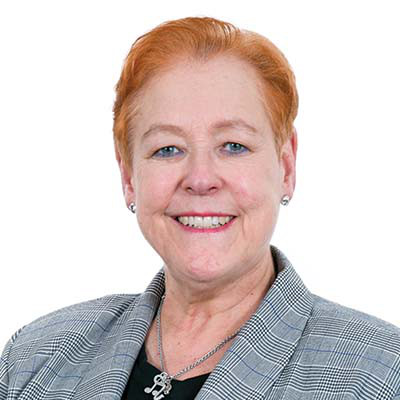
Mrs Rosemary Maritz, head of the Music Department 1998–2020, winner of the competition to compose music for the rediscovered school song.
The lyrics are as follows:
- Per angusta ad augusta
- Per angusta ad augusta
- Per angusta ad augusta
- To this aim our lives we give.
- Through all trials unto triumphs,
- We will suffer, work and live
- From the knowledge that we gather
- Midst the warmth of friendly days.
- We will honour, love and cherish
- This our school in all our ways.
- Per angusta ad augusta
- Per angusta ad augusta
- Per angusta ad augusta
- To this aim our lives we give.
- Per angusta ad augusta
Audio 1.4 Piano accompaniment to the school song, composed and recorded by Mrs Rosey Maritz.
The role of the Rogan family
Mr Allister Rogan has served St Andrew’s as chairman of the St Andrew’s Trust for over 20 years from 2000 to 2022. His tremendous commitment and many contributions have left an important mark on the school.
The Rogan family was associated with St Andrew’s even before the enrolment of their two daughters at the school. In 1968, Mr Rogan was the school’s auditor and from 1984 to 1986 his father, Mr J A Rogan, was the school’s business manager and secretary to the board.
Mr Rogan and his wife, Jenny, were persuaded to send their daughters Katherine (Kate) and Nicola to St Andrew’s when Mr Frank Simmonds became headmaster. The girls matriculated in 1984 and 1986 respectively.
Mr Rogan was involved in school affairs as soon as his daughters were established at the school. He served as chairman of the Parents’ Association from 1979 to 1981 and for a second term from 1984 to 1986. He later commented that his most memorable and enjoyable achievement was serving as chairman of the 80th Anniversary Fête Committee in 1982. Amongst the celebrations was the Edwardian Fair, which raised funds for the building of a tuckshop/pavilion.
In 1986, Mr Rogan became a member of the board of directors taking over as chairman in 1990 after the death of Mr Peter Loveday. During that time, the Stephen Constance Media Centre and the Peter Loveday Foundation Centre were constructed. As the first part of ‘Vision 2002’, the Simmonds Block was built, and construction of the Frank Simmonds Resource Centre began to take shape.
In 1996 the “Jenny” bell, named for Mrs Jenny Rogan, was installed into the chapel bell support structure and dedicated on 11 May 1996. The ringing of this bell has become an established tradition for students and staff entering the Senior School for the first time and when they leave. It was also rung as a mark of respect and tribute to Mrs Rogan after her death in 2016.
Mrs Jackson describes Mr Rogan as “the generous godfather of the school” and many girls, staff and members of the St Andrew’s have highlighted his willingness over the years to support the school in any way he could.
The Allister Rogan Auditorium was named after him in 1999, in recognition of his great service to the school. In 2019, “Jenny’s Peace”, the heritage rose garden, was restored in loving memory of Mrs Rogan.
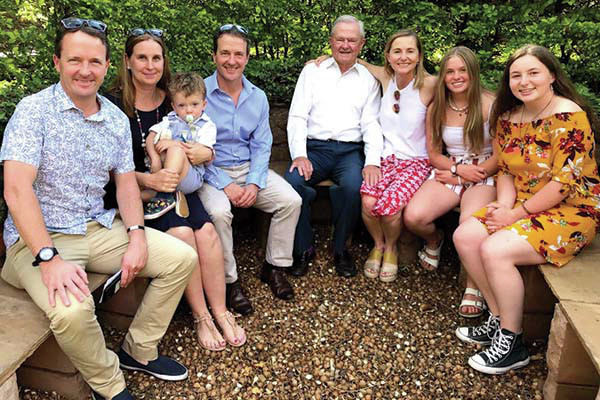
Figure 1.35 Members of the Rogan family at the annual Remembrance Service in 2019, held in the rose garden